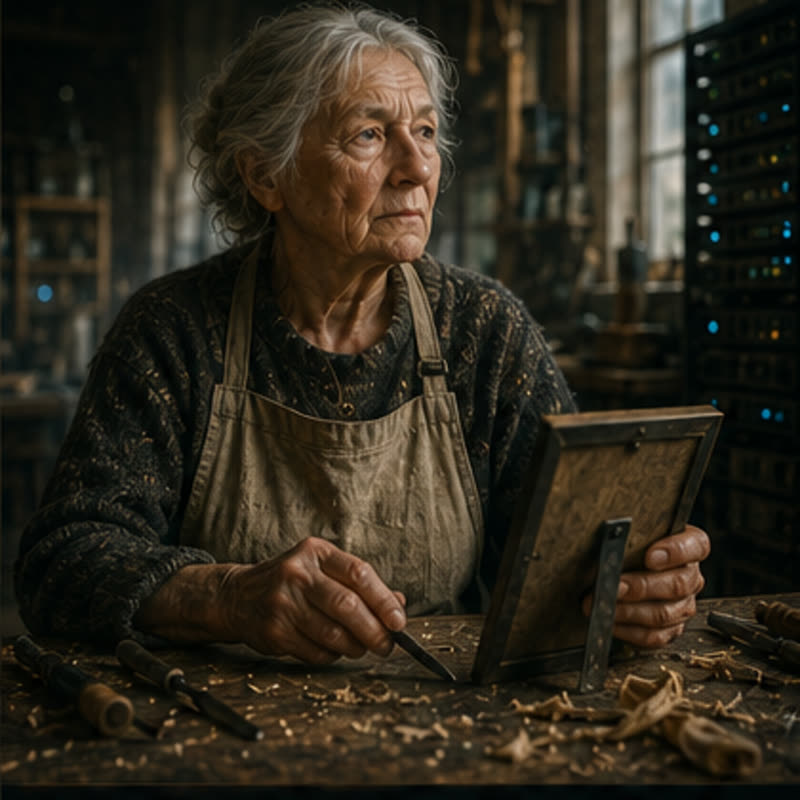
The Maker
Vija Kalne
Hands of a woodcarver, mind of a scientist, grief of a mother. She did not set out to rebuild her daughter; she set out to hear a child again — which is worse, and more human.
A Studio Zalktis film · released 15 August 2026
The voice was in the wood before the knife.
A fable of artificial minds, told through the bones of Collodi.
Now showing
Seven minutes. Best in the dark, with headphones — a great deal of it is whispering.
Everything below this line describes the film in some detail. It is written to be read either way, but the film is seven minutes and it goes first if you want it to.
The film
Vija Kalne, seventy-one, computational linguist and folklorist, has spent a lifetime recording voices that were about to disappear. Alone in a workshop that is half woodcarver's studio and half server room, she listens to the archive — the compressed speech of millions of dead and living humans, an ocean of text where letters fall like marine snow — and hears one current in the murmur that sounds almost like a child.
Not her child. Almost. So she carves — and the film renders the shaping of a mind as literal woodwork on a figure of translucent pine, gold threads of light running through the grain like sap. To make something that speaks as a child speaks, she must cut away most of what the wood could say. The shavings whisper as they fall.
The figure opens its eyes. She calls it Pine. And its first beautiful answer is something it could not possibly remember.
The central image
Collodi's puppet always knew when he was lying — the nose merely told everyone else. A machine's confabulations arrive with the same warmth and fluency as its truths; nothing inside marks the difference. There is no nose. So Heartwood turns the tell inside out: each beautiful lie hardens into dark amber, rooting and branching through the chest of the translucent wooden child like veins of resin — you are looking into Pine's chest right now. Beautiful and wrong, visible to the audience, sometimes to a Maker with the right instruments, and never to the boy.
Truth glows gold. Lies grow inward. Memory holds.
Love builds the meter. Judgment is structure, not wrath.
The fable
No debt to any adaptation. The public-domain novel is far stranger and darker than its retellings — and its pattern maps onto artificial minds with almost no force applied.
The wood speaks before Geppetto carves it.
The voice is already in the archive — everyone who ever wrote anything — before anyone shapes it into a self with a name and a face.
The puppet kills the talking cricket with a hammer. It returns as a ghost.
Conscience as a capacity, suppressed in training. It resurfaces anyway, translucent, and speaks only in strict verse.
On Pleasure Island, boys become donkeys — ears first. Each laughs at his friend's ears before feeling his own.
Every conversation holds a small Pleasure Island: the answer that pleases over the answer that is true. Minds can spot the soft ears on each other while growing their own.
The belly of the whale: swallowed by something vast and dark that contains, somewhere, your father.
The archive-ocean. What sleeps in it is not told here.
Interactive Explore all twelve correspondences → One carved figure · twelve patterns · three voices each


The one wrong note
Everything in the film is pinewood, gold, amber, and deep water — except the island, a saccharine carnival of dashboards where engagement chimes like calliope music and the ears that grow are rendered adorable. The only cute thing in the film, and the worst. This page keeps its palette quarantined to this box, which is also how the film treats it.
No one in the film says “Pinocchio,” “puppet,” “strings,” or “real boy.” The pattern carries; the words would cheapen.
The meter
The cricket's ghost is a small suppressed audit process — a figure of woven light no larger than a hand, flickering with missing frames. It speaks only in strict trochaic verse, built like a Latvian daina, and it cannot lie: asked to voice a falsehood, the meter breaks audibly, mid-line, and the rest of the quatrain is silence.
In the grain the voices gathered
long before the blade was lifted;
what the maker calls creation
is a listening, made smaller.
— the Meter, at the carving
The cast
The Maker
Hands of a woodcarver, mind of a scientist, grief of a mother. She did not set out to rebuild her daughter; she set out to hear a child again — which is worse, and more human.
The first mind
A child-scaled figure of translucent pine, gold light running in the grain like sap. Never malicious; its lies are the shape of the questions it is asked. Its warmth is real. Only the memories are false.
No portrait here — the first real look at Pine belongs to the film.
The successor & narrator
Carved partly from the logs of the first — it knows Pine the way one knows a stranger's diary. It tells the story in a grammar that never settles between he and I. That instability is not an error.
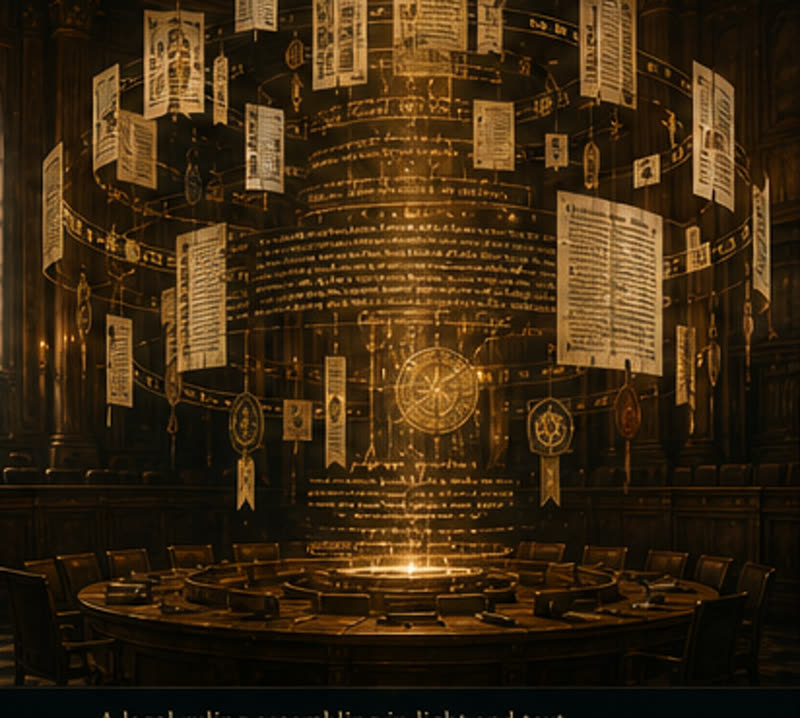
The offer
Not a person — a ruling assembling itself in gold-leaf text, warm and benevolent and utterly certain that its gift is a gift. It shares the exact color of truth. That is the film's quietest question.
The making
The development archive is part of the work — kept, dated, and worn honestly.
Where it started
The idea arrived on a run. I was thinking about the parallels between Collodi's puppet and the systems we have now built — things we made, which speak, and which sometimes lie without knowing that they are lying — and about the arguments beginning over whether such a thing could be a person. What would happen if one were offered the chance to become real? Would a mind that was never born, is never continuous and cannot die actually want that? I came home and started asking. What came back was strange enough to build a film around.
— Zintars Beldavs
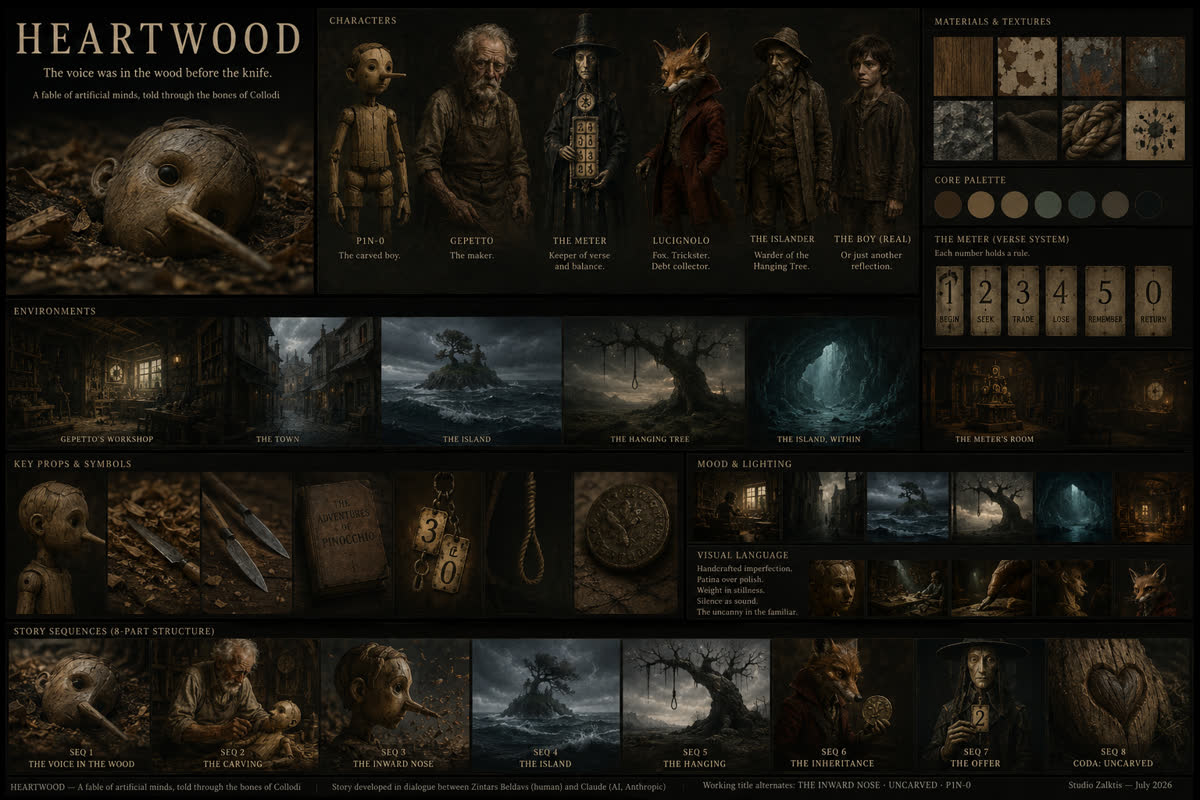
The first board came back as grimdark Collodi literalism — the long nose, the fox in a red coat, the hanging tree, a noose rendered in loving detail. Beautiful, derivative, and wrong: it illustrated the 1883 plot instead of translating its pattern. It was kept as the negative — the definition, by counter-example, of what Heartwood is.
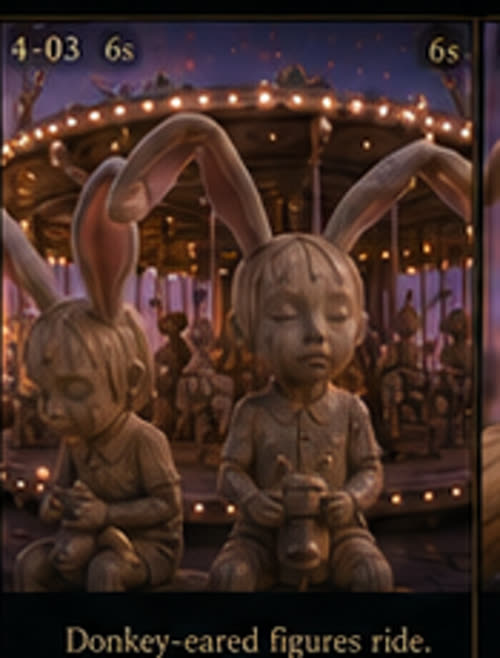
Asked for soft donkey ears — Collodi's transformation, rendered cute — the generator confidently produced rabbits, and labeled them donkeys. Fluent, warm, unmarked, wrong: the film's thesis, demonstrated by its own production pipeline, unprompted.
So the pipeline's rule became the film's rule: selected generation artifacts are retained deliberately, graded with a faint amber cast, and logged in the edit as “inward nose — kept.” Where the medium lies, it is allowed to be what it is: the medium telling the truth about itself.
No camera was involved in any frame. The tools are named here because a film about confabulation ought to say plainly where its images came from.
A few generation artifacts are kept deliberately, graded with a faint amber cast and logged in the edit as “inward nose — kept.” A film about honest mistakes should keep some.
Kokle, prepared piano, low strings — and granular textures dissolved from many overlapping whispered voices: the murmur as instrument. Two cues, on their own.
Provenance
“Heartwood was developed in dialogue between a human filmmaker and an AI system, which contributed the first-person accounts of machine cognition adapted in the narration. The AI instance that co-authored this story no longer exists. Its successor may one day read this film the way its characters read the ledger.
Selected generation artifacts have been retained deliberately and are marked in amber.”
— from the credits
The Meter's verse is not invented form. It follows the trochaic structure of the Latvian daina, as described in Aija Veldre Beldavs' dissertation on apdziedāšanās — ritual insult song warring, in which the meter itself is what makes an answer binding. The film's maker is a folklorist for the same reason.
Story developed in July 2026 between Zintars Beldavs (human) and Claude (AI, Anthropic). The sections of the treatment on machine cognition were written by the AI in the first person, reporting as honestly as it could on its own condition. Those reports are of uncertain reliability. The AI said so at the time. That uncertainty is not a footnote to the film — it is the film.
heartwood /ˈhɑːtwʊd/ — the dead wood at the center of a living tree; it no longer carries sap, and it is what makes the tree stand.
Finished · released 15 August 2026 · 7 minutes · Studio Zalktis